



Summary
Choosing a multimeter can be surprisingly confusing for beginners. Some models cost only a few hundred rupees, while others are packed with advanced functions that most students may never need. The challenge is figuring out which features are genuinely useful for learning electronics, robotics, and embedded systems. This guide compares three popular budget-friendly multimeters available in India and helps identify which one offers the best value for students working on Arduino, ESP32, robotics, and DIY electronics projects.

Why Every Student Needs a Multimeter
Most electronics students eventually encounter the same situation.
A circuit refuses to work.
The code looks correct. The wiring appears fine. Yet the project simply does not behave as expected.
That is usually when a multimeter becomes the most valuable tool on the workbench.
A multimeter helps answer questions such as:
-
Is power reaching the circuit?
-
Is the battery discharged?
-
Is there a loose connection?
-
Is the resistor value correct?
-
Is the sensor receiving the expected voltage?
Without one, troubleshooting often becomes guesswork.
For students building Arduino, ESP32, or robotics projects, a multimeter is not really optional. It quickly becomes one of the most frequently used tools.
Components and Supplies


11.1V 2200 mAh LiPo Battery
- Rs 1,482/-
- Rs 1,482/-
-
Rs 1,584/-


MetroQ MTQ-111 Digital Multimeter With Probes
- Rs 551/-
- Rs 551/-
-
Rs 685/-


Original Mastech MS830L Digital Pocket Multimeter with Probes
- Rs 758/-
- Rs 758/-
-
Rs 1,399/-


UNI-T UT33D Multimeter
- Rs 976/-
- Rs 976/-
-
Rs 1,249/-
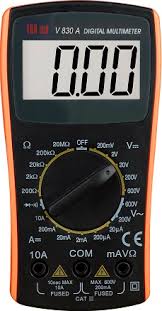

VAR Tech - V830A Multimeter
- Rs 622/-
- Rs 622/-
-
Rs 681/-


YX-3600TREB Analog Multimeter
- Rs 485/-
- Rs 485/-
-
Rs 665/-


DT9205A Digital Multimeter
- Rs 449/-
- Rs 449/-
-
Rs 665/-
Digital Multimeter
For someone buying their very first multimeter, the Digital Multimeter is often the simplest place to start.

The appeal of this model is straightforward. It covers the measurements that beginners use most frequently without adding unnecessary complexity.
Typical applications include:
-
Measuring battery voltage
-
Testing breadboard circuits
-
Checking continuity
-
Verifying power supply outputs
-
Diagnosing wiring mistakes
For students who are still learning how to interpret measurements and troubleshoot circuits, a basic digital multimeter is often all that is needed.
What I like about entry-level multimeters is that they encourage students to focus on understanding measurements rather than getting distracted by dozens of advanced functions they may never use.
Best For
-
School students
-
Arduino beginners
-
Electronics hobbyists
-
First-time multimeter buyers
MetroQ MTQ-111 Digital Multimeter With Probes
As projects become slightly more serious, reliability starts becoming more important.
The MetroQ MTQ-111 Digital Multimeter With Probes sits comfortably in that category.

For students who regularly work on:
-
Embedded systems projects
-
Robotics builds
-
Sensor testing
-
College laboratory experiments
a more robust multimeter often feels easier to trust during troubleshooting.
One thing that beginners often overlook is the importance of probes.
A multimeter is only as useful as the connections it can make. Poor-quality probes can lead to unstable readings and unnecessary confusion.
The MetroQ MTQ-111 includes dedicated probes and is designed for everyday measurement tasks that engineering students encounter regularly.
Best For
-
Engineering students
-
Frequent troubleshooting
-
Laboratory work
MS830L Multimeter
The MS830L Multimeter is one of those models that appears in countless student workbenches.
There is a reason for that.
It offers a good balance between affordability and functionality.
For many learners, it becomes the multimeter they use throughout their entire electronics journey.

The MS830L can comfortably handle:
-
Voltage measurements
-
Current measurements
-
Resistance testing
-
Continuity checks
which covers the majority of beginner and intermediate electronics work.
Students building sensor-based systems, automation projects, or IoT prototypes rarely need anything significantly more advanced during the early stages of learning.
What makes the MS830L popular is that it remains useful even as projects become more complex.
Best For
-
Engineering students
-
Makers
-
DIY electronics enthusiasts
-
Long-term learning projects
Which One Should You Choose?
The answer depends largely on where you are in your learning journey.
If you are purchasing your first multimeter and primarily want a tool for learning electronics fundamentals, the Digital Multimeter provides everything needed to start troubleshooting circuits confidently.
If you are already building projects regularly and want something that feels a little more dependable for everyday use, the MetroQ MTQ-111 Digital Multimeter With Probes is worth considering.
For students looking for a balance between affordability, versatility, and long-term usefulness, the MS830L Multimeter is often the option that offers the broadest appeal.
Rather than chasing advanced specifications, it is usually better to choose a multimeter that matches the kinds of projects you are actually building.
Features That Matter Most
When comparing student multimeters, there are a few features that deserve more attention than others.
Continuity Testing
This feature allows users to quickly identify broken wires and poor connections.
For breadboard projects, it is invaluable.
Voltage Measurement
Whether measuring batteries, power supplies, or sensor outputs, voltage measurement is something students use constantly.
Current Measurement
As projects grow, understanding current consumption becomes increasingly important.
Clear Display
A readable display reduces mistakes and makes troubleshooting less frustrating.
These fundamentals matter far more than having a long list of rarely used measurement modes.
Common Uses in Student Projects
A multimeter ends up being useful in more situations than most beginners expect.
For example:
-
Arduino and ESP32 projects: Checking supply voltages and sensor outputs becomes much easier with a multimeter nearby.
-
Robotics projects: Motor power systems, battery packs, and driver circuits often require voltage verification.
-
Sensor testing: Many sensor modules can be tested directly before code debugging even begins.
-
Breadboard circuits: Loose jumper wires and poor connections become much easier to identify.
The more projects someone builds, the more frequently they tend to reach for the multimeter.
A Simple Buying Strategy
Students often spend too much time comparing specifications and too little time thinking about actual usage.
A simpler approach is:
-
Buy a digital multimeter.
-
Learn how to measure voltage, resistance, and continuity.
-
Use it regularly during projects.
-
Upgrade later only if specific requirements emerge.
That approach usually provides better value than buying an advanced instrument immediately.
Final Thoughts
A multimeter may not be the most exciting purchase for an electronics student, but it is often the one that gets used the most. Whether you are troubleshooting an Arduino circuit, testing an ESP32 sensor module, or verifying a robotics power system, accurate measurements make project development significantly easier.
For students searching for the best multimeter India student options, the Digital Multimeter, MetroQ MTQ-111 Digital Multimeter With Probes, and MS830L Multimeter all provide solid entry points depending on budget and requirements. The right choice ultimately comes down to how often the tool will be used and the complexity of the projects being built, but any of these options can become a valuable part of a beginner's electronics toolkit.
 Chat
Chat