1. What is the Arduino Nano Original?
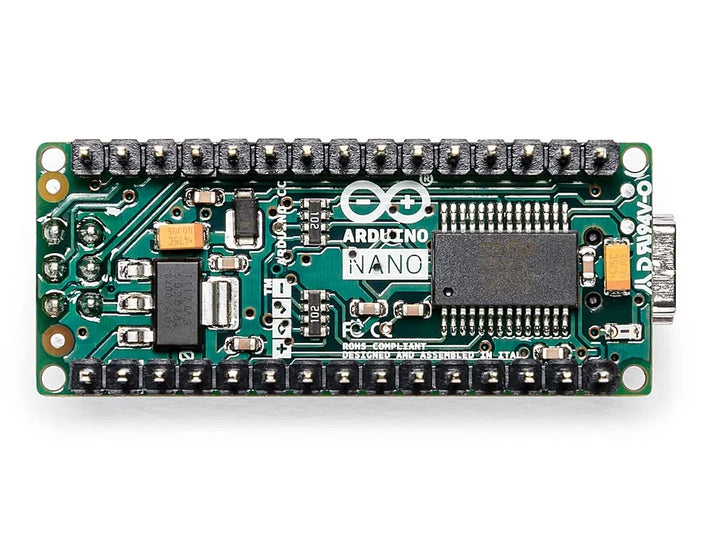
The Arduino Nano Original is a compact Arduino development board based on the ATmega328P microcontroller. It provides 14 digital I/O pins, 8 analog inputs, and a 16 MHz clock speed in a small, breadboard-friendly form factor, making it suitable for electronics prototyping, robotics, automation, sensor projects, and embedded applications.
2. How many digital and analog pins does the Arduino Nano have?
The Arduino Nano Original provides 14 digital I/O pins and 8 analog input pins. Six of the digital pins can be used for PWM output, while the analog inputs provide 10-bit resolution for reading analog signals from sensors, potentiometers, and other electronic components.
3. How is the Arduino Nano powered?
The Arduino Nano can be powered through its mini USB connection or through the VIN pin using an appropriate external power source. It operates at 5V and is commonly used with a recommended input voltage in the 7V–12V range when supplying power through VIN.
4. Is the Arduino Nano suitable for breadboard projects?
Yes. The compact design and dual-row pin arrangement make the Arduino Nano Original particularly convenient for breadboard prototyping. It is a popular choice for projects where the functionality of an Arduino Uno is required but PCB space is limited.
5. What can I build with an Arduino Nano?
The Arduino Nano can be used for a wide range of projects, including sensor monitoring systems, home automation, robotics, LED controllers, data loggers, motor-control projects, and other DIY electronics applications. Its compact size makes it especially useful for space-constrained projects.








 Chat
Chat


