Black Gladiator - Tracked Robot Chassis - Buy Online in India
Black Gladiator - Tracked Robot Chassis
23 reviews
Rs 2,899/-
- 42%
Rs 2,899/-
Rs 4,999/-
Save Rs 2,100/-
🪙
RC REWARDS
Earn
28
RC Coins
on this order
2
sold in last
8
hours
Incl. GST (No Hidden Charges)
Found a better price?
Let us know! We'll try to match the price for you
Please hurry! Only 12 left in stock
SKU:
TIFKT0082
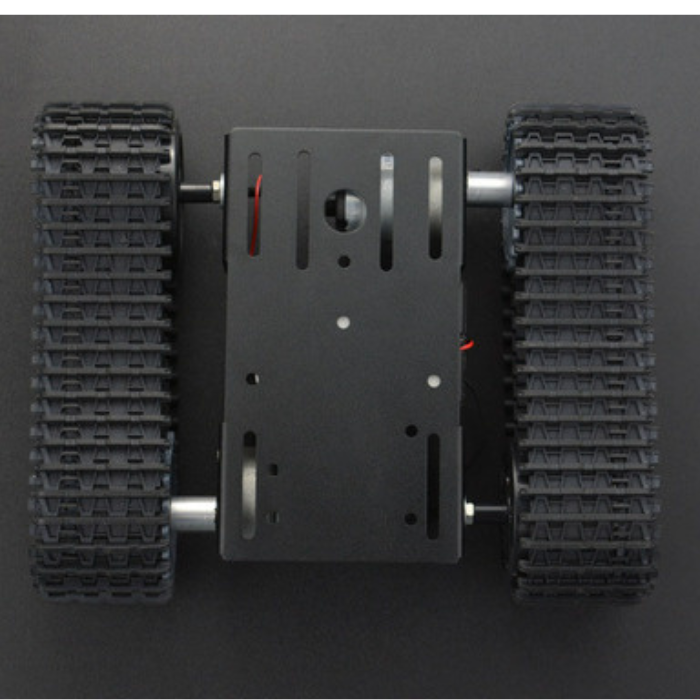
Agile and Easy to Control: Black Gladiator is an Arduino-controllable tracked robot chassis, providing a stable and durable solution for your robotics projects.
Endless Possibilities: Includes two quality motors for versatile DIY robot car projects, suitable for various road surfaces. Perfect for Arduino fans and smart robot car enthusiasts.
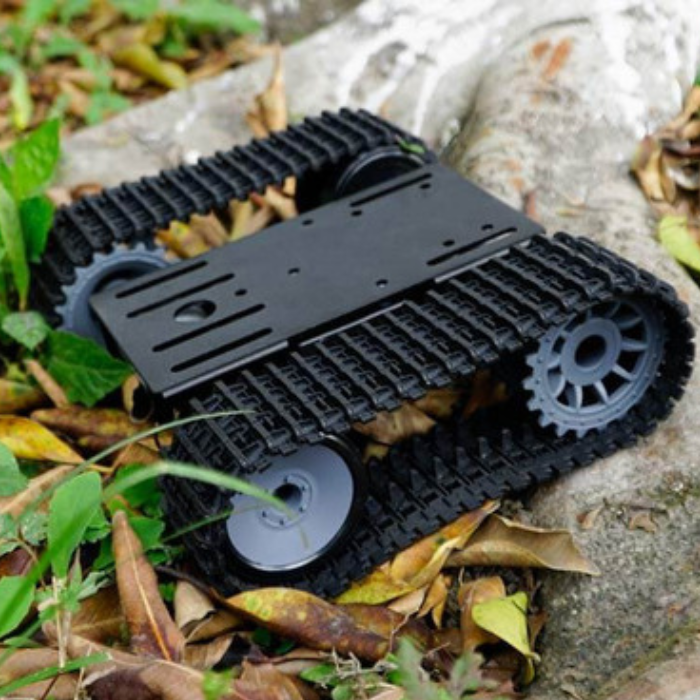
High-Strength Alloy Base: The chassis features a high-strength aluminum alloy base, ensuring stability and durability. Engineering plastic tracks provide good elasticity and road grip.
Expandable Design: Compatible with Arduino microcontrollers and allows integration with additional electronic components like IR sensors, ultrasonic sensors, cameras, LEDs, displays, WIFI modules, etc.
Easy Assembly: Unassembled chassis with installation tutorial provided. Explore more possibilities with customizable features and expand your robotics projects.
Bulk Order?
For Best Price Contact on WhatsApp for bulk discounts!
Or Fill the Form Below
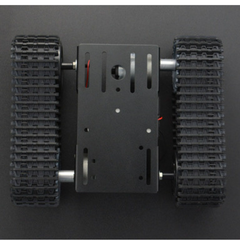
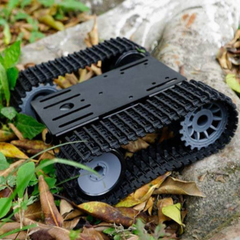
The Black Gladiator - tracked robot chassis is your ideal solution for agile and easy-to-control robotics projects. This Arduino-compatible tracked robot chassis features a high-strength aluminum alloy base, delivering excellent stability and durability. The engineering plastic tracks ensure good elasticity and superior road grip, making this tracked chassis suitable for a variety of terrains.
With two quality motors, this gladiator chassis opens up endless possibilities for DIY robot car projects. Perfect for Arduino enthusiasts and smart robot car lovers, the Black Gladiator allows seamless customization with additional electronic components such as IR sensors, ultrasonic sensors, cameras, LEDs, displays, WiFi modules, and more.
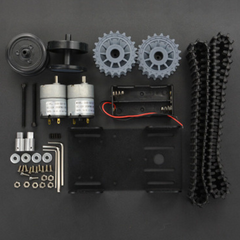
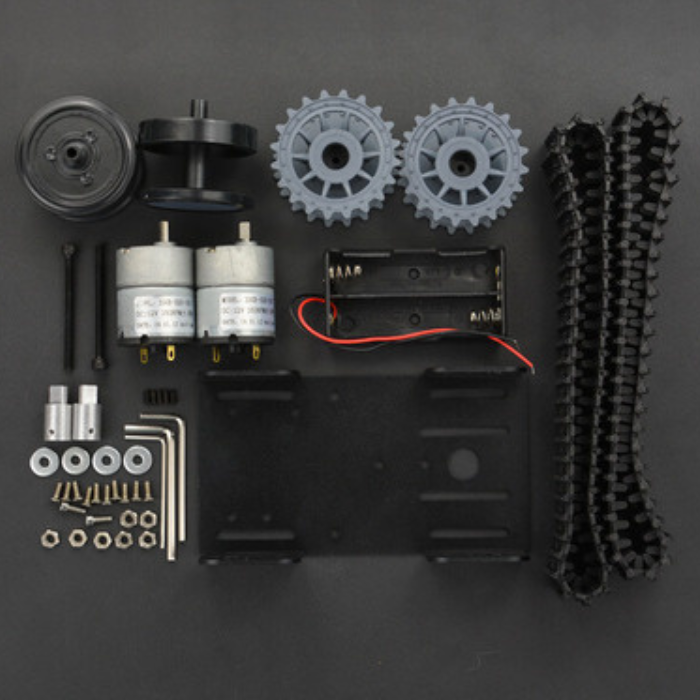
Assembled with dimensions of 19.3 × 16.3 × 6 cm and a net weight of 0.47 kg, this tracked robot chassis operates within a voltage range of 6V–12V. The sandblasting oxidation surface treatment enhances both durability and aesthetics. The package includes the chassis base, two motors, two tracks, two bearing wheels, two drive wheels, a set of screw accessories, a hex wrench, and a battery holder.
Solve your robotics challenges with this easy-to-assemble and customizable tracked robot chassis. Explore the world of robotics with the Black Gladiator.
Why Choose a Tracked Robot Chassis?
A tracked robot chassis like the Black Gladiator provides better traction and stability compared to wheeled robots, especially on uneven surfaces. The gladiator chassis design ensures improved load distribution and maneuverability, making it ideal for robotics enthusiasts, educational projects, and advanced DIY builds. If you're looking for a reliable tracked chassis for multi-terrain performance, this platform is a strong choice.
Features:
Arduino-controllable tracked robot chassis
High-strength aluminum alloy base for stability and durability
Engineering plastic tracks for excellent elasticity and grip
Two quality motors for versatile DIY robot car projects
Compatible with Arduino microcontrollers
Expandable tracked chassis design for additional components
Easy assembly with provided installation tutorial
Applications:
Agile Robotics Projects: The Black Gladiator-Tracked Robot Chassis is ideal for agile and easy-to-control robotics projects.
DIY Robot Car Projects: With two quality motors, it opens up endless possibilities for DIY robot car projects.
This product comes with a 1-year manufacturer warranty from the date of purchase, covering manufacturing defects only.
Warranty Void If:
The product shows signs of physical damage, mishandling, exposure to water/moisture, fire, natural calamities, unauthorized repairs, improper storage near heat or direct sunlight, or alteration in any way.
DIY kits provide a structured way to learn electronics, robotics, coding, and STEM concepts through hands-on projects. This collection includes kits suited to school students, engineering students, hobbyists, and makers, with options ranging from beginner-friendly learning kits to more advanced robotics projects. Depending on the kit, the box may include electronic components, sensors, motors, a controller or development board, mechanical parts, connecting wires, and project-specific accessories, allowing learners to start building without sourcing every component separately.
DIY Robotics & STEM Kits for Kids in India
STEM kits make science, technology, engineering, and mathematics more engaging by turning concepts into hands-on activities. Instead of learning only through textbooks, children can build, experiment, assemble, and solve practical challenges using age-appropriate projects.
This collection includes DIY robotics and STEM kits for school students, engineering students, hobbyists, and makers. Depending on the kit, the box may include motors, sensors, circuit boards, mechanical components, controllers, connecting wires, and other project-specific parts. Choosing the right kit depends on the learner's age, experience, interests, and the level of electronics or programming involved.
STEM Robotics Kits for Hands-On Learning
STEM robotics kits combine concepts from electronics, mechanics, programming, and automation into practical projects. They can help learners understand how individual components work together to create a functioning system.
Beginner kits may introduce simple concepts such as motors, switches, movement, circuits, and cause and effect. More advanced kits can involve sensors, microcontrollers, programming, IoT, and autonomous robotics.
For schools and STEM labs, robotics kits can support project-based activities where students work through a problem, assemble a solution, test it, and make improvements. For hobbyists and engineering students, more advanced kits can provide a starting point for experimentation and custom projects.
Robotics Kits for School Education
Robotics kits can make classroom learning more practical by allowing students to apply concepts through physical projects. Depending on the kit, students can explore basic electronics, mechanical systems, sensors, coding, and automation.
Schools can select kits according to the students' grade level, curriculum requirements, teaching objectives, and available classroom resources. A suitable kit should also provide enough components for students to build and experiment without requiring extensive additional hardware.
For institutions setting up dedicated practical-learning environments, these kits can be used alongside other equipment to support robotics, electronics, coding, and STEM activities across different grades.
What Do STEM Kits Typically Include?
The contents of a STEM kit vary according to its purpose and complexity. A basic kit may contain mechanical parts and simple components, while an electronics or robotics kit may include a wider range of hardware.
Common components include:
Motors and wheels
Sensors
Circuit boards or development boards
LEDs, switches, and other electronic components
Connecting wires and connectors
Chassis or structural components
Gears and mechanical parts
Batteries or battery holders
Assembly hardware
Project-specific accessories
Before purchasing, check the product contents to determine whether the kit includes all the components required for the intended project.
2026 Price List of STEM Kits in India
STEM kit prices vary according to the number of components, project complexity, electronics included, and intended learning level. The following examples represent different price points available in the collection.
Product
Price
DIY Creeping Tiny Gecko
₹249
4WD Four Wheel Drive Kit – A Smart Robot Car with Chassis
₹575
DIY Uno Project Smart Robot Car Kit V3.0
₹6,049
5 in 1 Sensor Kit for Arduino
₹395
DIY Educational Electric Reptile Robot for Science Experiment
₹210
Solar Powered Black Cockroach Bug Toy
₹186
DIY Colorful Wind Generator Car
₹365
DIY Conversion of Energy Science Experiment by LED Alarm Clock using Potato
₹288
DIY Tesla Coil Mini Kit Wireless Electric Power Transmission
₹198
DIY D2-5 Intelligent Tracking Line Car Kit
₹238
14 in 1 Educational DIY Solar Transformers Robot Toy
Arduino Robotics Kit for Grade 8 | Ekya School, CMR
₹1,614
BBC Micro:Bit V2.2 Go Kit
₹1,860
37 in 1 Sensors Kit for Arduino
₹1,081
Smart AI Lens Kit for Micro:Bit by Elecfreaks
₹3,950
Prices are indicative and may change based on product availability and current listings.
Age-Based STEM Kit Recommendation Chart
Selecting a STEM kit according to age and experience can make the learning process more accessible. Younger learners generally benefit from simple construction and cause-and-effect activities, while older students can work with programming, sensors, and microcontrollers.
Basic mechanical concepts, motor skills, and introductory STEM activities
Solar mechanical and beginner building kits
8–10 years (Primary / Middle School)
Beginner electronics, motors, circuits, and basic robotics
Sensor, transportation, and mini robotics kits
11–13 years (Pre-teens / Early Teens)
Intermediate electronics, sensors, programming, and mechanical projects
Smart factory and robotic arm kits
14–16+ years (Teens / Advanced Learners)
Programming, microcontrollers, IoT, AI, and advanced robotics
Arduino robotics and advanced IoT/AI kits
Age recommendations should be treated as a general guide rather than a strict requirement. A learner's previous experience, ability to follow instructions, and familiarity with electronics or programming should also be considered.
Choosing the Right DIY STEM Kit
The best DIY STEM kit depends on who will use it, what they want to learn, and how complex the project should be.
Requirement
What to Look For
Young beginners
Simple assembly, larger components, and minimal electronics
School students
Curriculum-relevant projects and guided activities
Older students
Sensors, electronics, coding, and programmable controllers
Engineering students
Modular hardware and scope for experimentation
Hobbyists
Customizable kits with opportunities for modifications and upgrades
STEM labs
Reusable components and projects suitable for multiple learners
For beginners, a complete kit with clearly defined components and instructions can make the first project easier to manage. Learners with more experience may benefit from kits that provide greater flexibility for programming, circuit modifications, and mechanical experimentation.
STEM Kits for Schools, Students & Hobbyists
Different users may have different goals when selecting a kit.
For schools, STEM kits can support classroom demonstrations, group activities, science fairs, robotics clubs, and practical assignments.
For engineering students, more advanced robotics and electronics kits can provide a platform for learning about sensors, microcontrollers, automation, and embedded systems.
For hobbyists and makers, DIY kits offer an accessible way to experiment with robotics, electronics, mechanical systems, and programming while developing projects outside a formal classroom environment.
STEM project kits include DIY kits, science experiment kits, and educational innovation kits designed to provide hands-on learning. They help students explore concepts from science, technology, engineering, and mathematics through experiments, assembly, and practical activities.
2. Where to Buy DIY Robot Kits?
DIY robot kits are available in different configurations for beginners, school students, hobbyists, and advanced learners. When choosing a kit, consider the learner's age, skill level, type of project, included components, and programming requirements.
3. What is Included in a DIY Kit?
The contents depend on the type of kit, but a DIY kit may include electronic components, sensors, motors, mechanical parts, a controller or development board, connecting wires, and project-specific accessories. Some kits also include assembly instructions or project guides to help learners complete the activity.
4. What is a STEM Kit?
A STEM kit is an educational tool that provides hands-on learning experiences in Science, Technology, Engineering, and Mathematics. These kits typically include the components and materials required to complete projects or experiments, helping learners develop problem-solving skills, creativity, and an understanding of real-world applications.
5. Which Kit Suits a Class 8 Student?
For a Class 8 student, an intermediate STEM or robotics kit that introduces electronics, sensors, motors, circuits, and basic programming is generally suitable. Arduino-based robotics kits, sensor projects, and programmable robot kits can provide an appropriate level of hands-on learning, depending on the student's existing experience.
6. What is the Best Age to Learn STEM?
STEM learning can begin as early as 3–5 years with simple kits focused on basic patterns, construction, and problem-solving. Children aged 6–12 can explore circuitry, mechanics, electronics, and basic coding, while teenagers can progress to robotics, programming, AI, IoT, and more advanced engineering projects.
7. Can I Return or Exchange a Kit if Needed?
Return or exchange eligibility depends on the condition of the product and the applicable return policy. If a kit arrives damaged, incomplete, or has another eligible issue, customers can initiate the applicable return or exchange process by raising a support ticket.
8. Do You Supply Kits in Bulk to Schools?
Yes, STEM and robotics kits can be supplied in bulk to schools and other educational institutions. Bulk requirements can be evaluated based on the number of students, kit type, curriculum requirements, and project objectives. Schools can contact the sales team for customized requirements, bulk pricing, and procurement support.
Choosing a selection results in a full page refresh.
I think OV3660 is a good module,but there should be an option for OV2640 too,cause esp32 cam performs better with OV2640. OV3660 will heat very fast and the streaming will be slow,but it has its own use like it has better resolution and better low light image processing.








 Chat
Chat


