Fermion MEMS Gas Detection Sensor Carbon Monoxide (CO) (Breakout, 5-5000ppm)
2A Dual L298N Motor Driver Module with PWM Control
Let us know!
We'll try to match the price for you
Couldn't load pickup availability
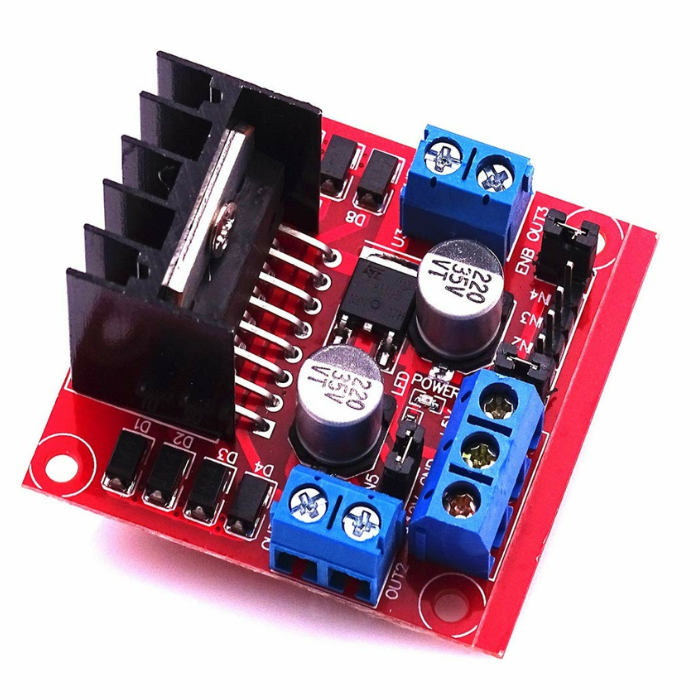
The L298N Motor Driver Module is a great choice for controlling motors! It contains a double H bridge L298N chip, which has a maximum voltage of 46V and a current of 2A. This L298N dual H bridge motor driver for Arduino works with a logic voltage of 5V and can drive motors with a voltage range of 5–35V, making it a reliable motor driver module for DC motor and robotics applications.
One cool feature of the L298N-based motor driver module is that it has current sensing for each motor, so you can easily check how they’re performing. It also features a heatsink to keep it cool while running, which increases efficiency. Also, there is a power-on LED indicator that indicates when it is active. The L298N Module is perfect for controlling DC and Stepper motors, switches, relays, robotic cars, arms, etc., making it the best motor driver module for Arduino projects for beginners and developers alike.

| Pin Name | Description |
|---|---|
| IN1 & IN2 | Motor A input pins. Used to control the spinning direction of Motor A. |
| IN3 & IN4 | Motor B input pins. Used to control the spinning direction of Motor B. |
| ENA | Enable pin for Motor A — allows PWM speed control of Motor A. |
| ENB | Enable pin for Motor B — allows PWM speed control of Motor B. |
| OUT1 & OUT2 | Output pins to Motor A — these connect to the two leads of Motor A. |
| OUT3 & OUT4 | Output pins to Motor B — these connect to the two leads of Motor B. |
| 12V | 12V (or motor supply) input from DC power source — supplies power to the motors. |
| 5V | Logic supply pin (5 V) — supplies power for the internal switching logic circuitry in the L298N IC. |
| GND | Ground pin — common reference for the logic and motor power supply. |
| Specification | L298N | L293D | BTS7960 |
|---|---|---|---|
| Operating Voltage | 5V – 35V | 4.5V – 36V | 6V – 27V |
| Output Current (per channel) | Up to 2A | Up to 600mA | Up to 43A |
| Number of Channels | 2 (Dual H-Bridge) | 2 (Dual H-Bridge) | 1 (Single H-Bridge) |
| PWM Control | Yes (ENA/ENB Pins) | Yes (Enable Pins) | Yes (PWM Input Pins) |
| Logic Voltage | 5V | 5V | 3.3V – 5V compatible |
| Heat Dissipation | Moderate (Built-in Heat Sink) | Low (Needs external cooling for high load) | High (Integrated powerful MOSFETs with heat sink) |
| Motor Type Supported | DC Motors, Stepper Motors | DC Motors, Small Steppers | High-Power DC Motors |
| Efficiency | Medium (BJT-based) | Low (BJT-based) | High (MOSFET-based) |
| Suitable For | Robotics, Medium DC Motors | Basic Projects, Low-Power Motors | High-Torque Motors, Electric Vehicles |
| Specification | Details |
|---|---|
| Driver Model | L298N 2A |
| Driver Chip | Double H Bridge L298N |
| Motor Supply Voltage (Maximum) | 46V |
| Motor Supply Current (Maximum) | 2A |
| Logic Voltage | 5V |
| Driver Voltage | 5-35V |
| Driver Current | 2A |
| Logical Current | 0-36mA |
| Maximum Power (W) | 25W |
| Current Sense for Each Motor | Yes |
| Heatsink | Yes |
| Power-On LED Indicator | Yes |
| Weight (gm) | 25 |
| Dimensions (mm) | 44 x 44 x 28 (L x B x H) |
A single L298N motor driver module is designed as a dual H-bridge, meaning it can control two DC motors independently. To control 8 motors, you would require four separate motor driver boards. You would wire each board to your microcontroller, allowing you to manage all motors in your project.
To control the L298N motor driver, you send logic signals from a microcontroller to its input pins (IN1-IN4) to set the direction of rotation. For speed control, you apply PWM signals to the enable pins (ENA and ENB). This method provides precise and reliable DC motor control for your robotics projects.
To control the motor driver with your phone, you need to create a wireless link using an Arduino and a communication module, such as Bluetooth or Wi-Fi. A mobile app sends commands to the Arduino. The Arduino then processes these commands and signals the motor driver board to operate the motors accordingly.
The L298N motor driver module serves as a high-power switch that allows a low-power microcontroller to operate motors safely. You connect your motors to the output terminals, provide a suitable power supply, and send control signals for direction and speed. It is a versatile module that can drive two DC motors or one bipolar stepper motor.
You need a motor driver module because a microcontroller's pins cannot supply enough current to run a motor directly. The L298N motor driver board is a popular choice that takes low-current control signals and amplifies them. This enables both direction control and precise PWM-based speed control.
Using a standalone motor driver module instead of a stacked Arduino motor shield offers much greater flexibility in your project design. This approach allows for custom wiring and component placement. It also provides more versatile power supply options, as you are not limited by the fixed form factor of a shield.
To use the driver module with an Arduino, connect the module's logic pins to the Arduino's digital output pins and provide a separate power source for the motors. In your code, you send digital signals to control the motor's direction and PWM signals for speed. The L298N motor driver is an excellent choice for this, with plenty of examples and libraries available.

The L298 motor driver module is used to control the speed and direction of DC and stepper motors in robotics and automation projects. It is widely used as a motor driver module for DC motor and robotics, especially in Arduino-based systems.
The module works by receiving input signals from Arduino and controlling motor direction via H-bridge circuits. The L298N dual H bridge motor driver for Arduino allows independent control of two motors using digital and PWM signals.
The L298 motor driver can control DC motors and bipolar stepper motors. It is commonly used in robotics due to its compatibility and flexibility as a motor driver module for DC motor and robotics.
The L298N motor driver module supports a maximum current of 2A per channel, making it suitable for medium-power motor applications.
To connect the module, wire the input pins to Arduino digital pins and connect motors to output terminals. Providing proper power supply and understanding the L298N motor driver pinout and working ensures correct functionality.
The L298 motor driver module price in India varies depending on the supplier, quality, and availability. Platforms like Robocraze offer competitive pricing along with genuine products.
Yes, due to its reliability, affordability, and ease of use, it is often considered the best motor driver module for Arduino projects, especially for beginners and educational purposes.