1. Can the TB6612FNG control stepper motors?
Yes. Because the TB6612FNG contains two independent H-bridges, it can drive a small bipolar stepper motor. However, ensure your stepper motor’s coil current does not exceed the module’s 1.2A continuous (3.2A peak) rating per channel.
2. What’s the difference between the TB6612FNG and the L298N?
The TB6612FNG is significantly more compact and efficient. It uses MOSFET outputs, resulting in a much lower voltage drop and less heat generation compared to the L298N’s BJT design. While the L298N can handle slightly higher currents, it requires a bulky heatsink and wastes more power as heat. The TB6612FNG is the superior choice for battery-powered and space-constrained robotics projects.
3. Is a heatsink required for the TB6612FNG?
No, a heatsink is generally not required under normal operating conditions (up to 1.2A continuous per channel). Its efficient MOSFET design keeps it cool. However, if you plan to push the module near its 3.2A peak current for extended periods, adding a small heatsink or ensuring active airflow is recommended.
4. Why choose TB6612FNG over L298N?
The TB6612FNG is significantly more compact and efficient. It uses MOSFET outputs, resulting in a much lower voltage drop and less heat generation compared to the L298N’s BJT design. While the L298N can handle slightly higher peak currents, it requires a bulky heatsink and wastes more power. The TB6612FNG is the superior choice for battery-powered robotics.
5. What does the STBY pin do?
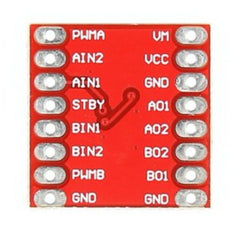
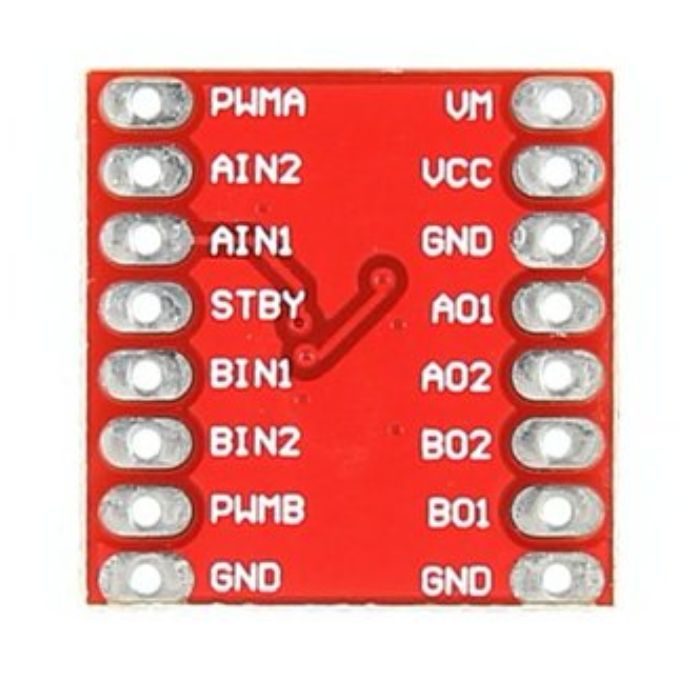
The STBY (Standby) pin is a power-saving feature. When pulled LOW, the driver enters a low-power standby mode, cutting output to the motors. To operate the motors, you must pull the STBY pin HIGH (e.g., connect it to a 5V logic signal or an Arduino digital pin set to HIGH).
6. Can it drive N20 micro DC motors?
Yes, absolutely. The TB6612FNG is perfectly suited for N20 micro DC motors. Since N20 motors typically draw well under the 1.2A continuous (and 3.2A peak) limit of this driver, it provides smooth, efficient, and cool-running control for small robotic platforms.
7. Can I use the TB6612FNG with 3.3V microcontrollers like ESP32 or Raspberry Pi?
Yes, absolutely. The logic supply voltage (VCC) for the TB6612FNG ranges from 2.7V to 5.5VDC. This makes it natively compatible with 3.3V logic systems like the ESP32, Raspberry Pi, or STM32, without requiring any external logic level shifters.
8. What is the maximum PWM frequency, and does it prevent motor whine?
The TB6612FNG supports a PWM input signal frequency of up to 100kHz. This is a major advantage over older drivers like the L298N (which typically operate at 1–20kHz). By running at higher frequencies, the TB6612FNG pushes the switching noise above the range of human hearing, resulting in silent, smooth, and highly efficient motor control.
9. Can I power both the logic (VCC) and motor (VM) from the same battery?
Yes, but it depends on your battery voltage. If you are using a power source between 2.7V and 5.5V (such as a 2S LiPo battery or 4x AA batteries), you can safely connect it to both the VM and VCC pins. However, if your motor supply (VM) is higher than 5.5V (up to the 15V max), you must use a separate 5V regulator (like a 7805 or buck converter) to supply the VCC pin, otherwise you will damage the logic circuitry.








 Chat


