



 Chat


I am highly impressed with the service. The support team resolved my print issue swiftly, and the delivery was both fast and securely packaged. The final print is of outstanding, A1 quality.
FlySky FS-CT6B 6ch 2.4GHz Transmitter & FS-R6B Receiver


Robocraze BEST PRICE GUARANTEED
50kg Load Cell with HX711 Weight Sensor
Let us know!
We'll try to match the price for you
For Best Price Contact on WhatsApp for bulk discounts!
Or Fill the Form Below

Couldn't load pickup availability

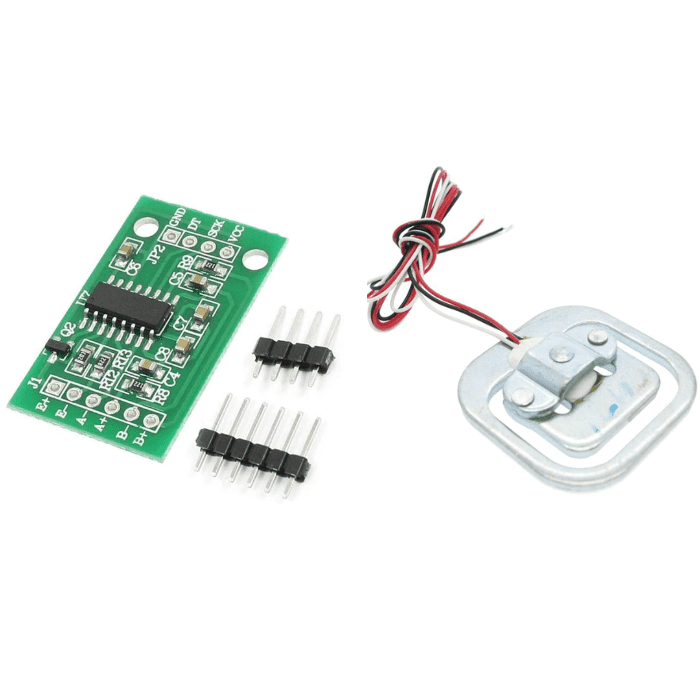
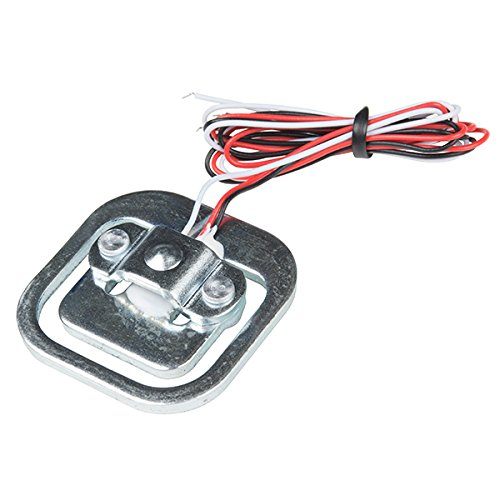
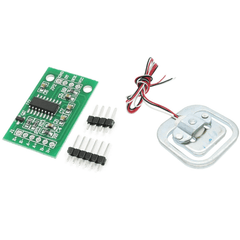
To accurately measure the weight and load of any object, engineers and hobbyists often use strain gauges. However, standalone strain gauges are fragile and can easily bend or break without a proper enclosure. To overcome this, our 50kg load cell hx711 combo comes with a durable metal enclosure to protect the internal strain gauge.
This load cell with hx711 features an internal resistance of 1000Ω and a half-bridge structure. You can connect external resistances to read the variation of resistance in a full bridge, or use two or four of these load cells to complete the bridge circuit. Using multiple load cells increases the overall weighing capacity, making them ideal for platform scales, electronic weighing machines, and belt scales.
When building a weight sensor Arduino project, you measure the change in resistance between the Red and White or Red and Black wires. Since this change is often microscopic, an external amplifier like the included HX711 breakout board is essential. It amplifies these small changes into readable values for your microcontroller or ADC ICs.
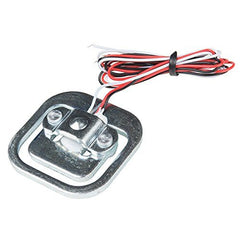
50kg Load Cell Features: This half-bridge body scale load cell sensor measures force applied to the outer side of the E-shaped strain beam. The strain gauge, affixed to the intermediate adhesive coating, bends under stress, allowing precise measurement while remaining protected from external physical barriers.
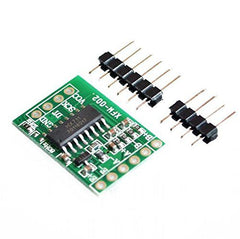
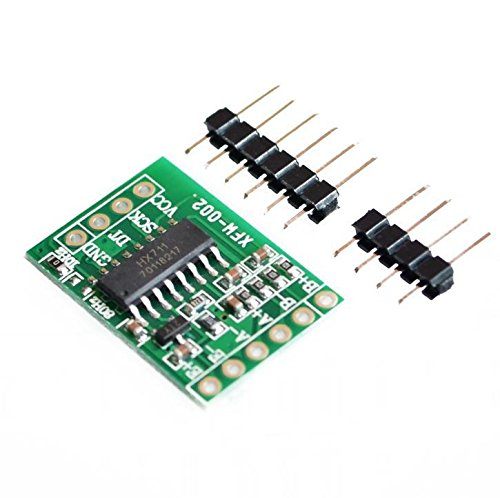
HX711 Amplifier Module: The dual-channel 24-bit precision A/D weight pressure sensor load cell amplifier and ADC HX711 module is a compact breakout board. It allows you to easily interface load cells with your microcontroller to measure weight accurately. With simple calibration, you can achieve highly accurate weight measurements for DIY industrial scales, process control, or presence detection projects. The HX711 uses a simple two-wire interface (Clock and Data) for communication, making it highly compatible with any microcontroller’s GPIO pins, backed by numerous open-source libraries.

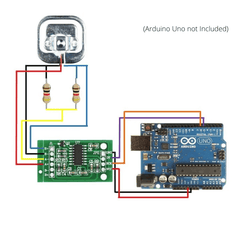
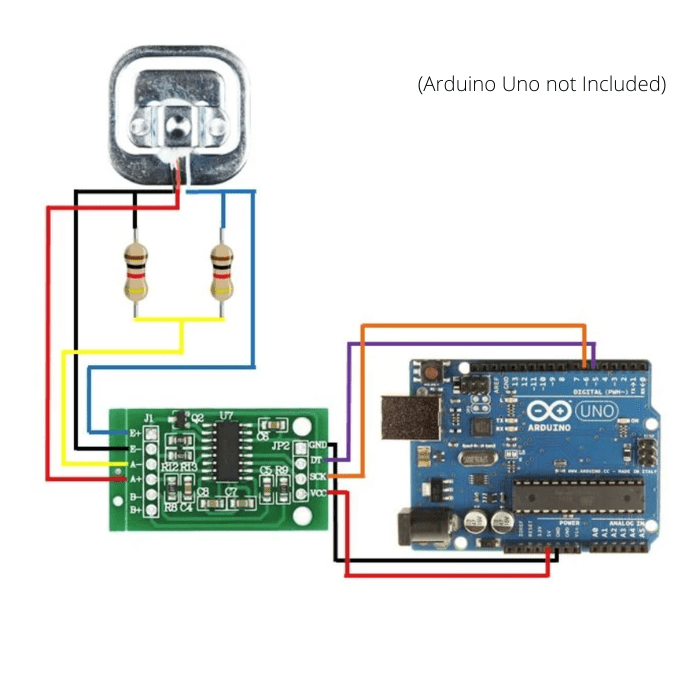
1. Combine the Load Cells (Full-Bridge Configuration):
2. Connect to HX711 Module:
3. Connect HX711 to Arduino:
Also check 50kg Load Cell available on the Robocraze website. It is described as an Alloy Steel wired weighing load cell with high accuracy, simple structure, and easy installation. The load cell is designed for use in hopper scales, platform scales, platform balance, belt scales, and other electronic weighing devices.
| Capacity (Kg) | 50 |
| Output Sensitivity (mv/v) | 1 ± 0.1 |
| Nonlinearity (%FS) | 0.03 |
| Repeatability (%FS) | 0.03 |
| Input Resistance (?) | 1000 |
| Insulation Resistance (M?) | 5000 |
| Dimensions(mm) | 34 x 34 x 8 |
| Weight (gm) | 20 |
| Cable Length (cm) | 30 |
| Operating voltage (v) | 5 ~ 10 |
| Current consumption | normal operation < 1.5mA |
| Operating Temperature (°C) | -40 ~ +85 |
| Length (mm) | 34.3 x 20 x 3 |
| Weight (gm) | 5 |
The Load Cell Sensor measures the correct force applied to the outer side of the sensor's strain E-shaped beam portion and the outer edges to form a shear force in the opposite direction i.e., middle strain beam bending necessary changes can occur under stress, strain beam side by another force should not be a barrier.
The HX711 is a precision 24-bit analog-to-digital converter (ADC) designed to interface directly with a bridge sensor in weighing scales and industrial control applications. It is designed to amplify cell signals and report them to another microcontroller.
HX711 is an electronic scale module whose working principle converts measured resistance value changes into electrical output via the conversion circuit.
The HX711 module is a breakout board for the HX711 IC that allows you to easily read load cells to measure weight. The HX711 module amplifies the load cell's low-voltage output and sends it to the microcontroller, which then calculates the weight based on this data.
The number of load cells depends on your platform design. For stable, accurate readings on rectangular platforms, four 50kg load cells (one at each corner) are recommended to handle uneven weight distribution, providing a combined capacity of 200kg. For smaller, cylindrical, or simpler projects, one or two load cells may suffice. Always ensure your combined load cell capacity exceeds your maximum expected weight by at least 20% for optimal accuracy and safety.
To calibrate your weight sensor Arduino setup, use the popular HX711 Arduino library (e.g., by bogde). First, run the included calibration sketch with no weight on the scale to tare it. Then, place a known, precise weight (e.g., 1kg or 5kg) on the sensor. The sketch will calculate a "calibration factor." Copy this factor into your main project code to ensure highly accurate weight measurements.
Fluctuating readings are usually caused by three factors: loose wiring, an unstable power supply, or mechanical interference. Ensure all connections to the load cell with HX711 are securely soldered (not just breadboarded), power the HX711 with a clean, stable 5V source, and verify that the load cell is mounted perfectly flat and rigid to prevent external vibrations from affecting the strain gauge.
While it is most famously used as a weight sensor Arduino project, the HX711 module is universally compatible. It communicates via a simple two-wire digital interface (Clock and Data). As long as your microcontroller (ESP32, Raspberry Pi, STM32, etc.) has configurable GPIO pins and a 3.3V/5V logic-compatible library, it will work perfectly.
Since this is a half-bridge sensor, you need two of them to complete a Wheatstone bridge for a standard scale. Wire them as follows:
(Note: If using four cells, wire them in parallel pairs following the 4-cell diagram provided above).
This load cell features a non-linearity and repeatability of 0.03% FS (Full Scale). In practical terms, this means the margin of error is roughly ±15 grams on a full 50kg load. However, real-world accuracy heavily depends on proper mechanical mounting, a stable power supply, and precise software calibration.
The HX711 IC offers two selectable output data rates: 10 SPS (samples per second) or 80 SPS. For standard weighing applications, 10 SPS is highly recommended as it provides the best noise rejection and stable readings. The 80 SPS mode can be enabled in code if you need faster, dynamic measurements for process control or presence detection.
50kg Load Cell with HX711 Weight Sensor
50kg Load Cell with HX711 Weight Sensor
These load cells are really simple to use. It gave a relatively accurate reading for my project. Super reasonable price too! Would definitely recommend it!
Sensor working good ans give good output
Fast delivery
Thanks for subscribing!
This email has been registered!
| Product | SKU | Description | Collection | Availability | Product Type | Other Details |
|---|
It is Amazing and great item in this price
Veri usefull and cheap price from other shopping site, I use this module many project. Thank you robocraze
I am highly impressed with the service. The support team resolved my print issue swiftly, and the delivery was both fast and securely packaged. The final print is of outstanding, A1 quality.
Good
it works👍
I am highly impressed with the service. The support team resolved my print issue swiftly, and the delivery was both fast and securely packaged. The final print is of outstanding, A1 quality.
FlySky FS-CT6B 6ch 2.4GHz Transmitter & FS-R6B Receiver