


 Chat
Chat


eSun 1.75mm PLA+ 3D Printing Filament 1kg Yellow Color
✨ Use RCAPP
and get 5% off 👇





SX1278 LoRa Module Ra- 02 433MHZ Wireless Spread Spectrum Transmission
Let us know!
We'll try to match the price for you
We’ll notify you once the product is back in stock.


Couldn't load pickup availability

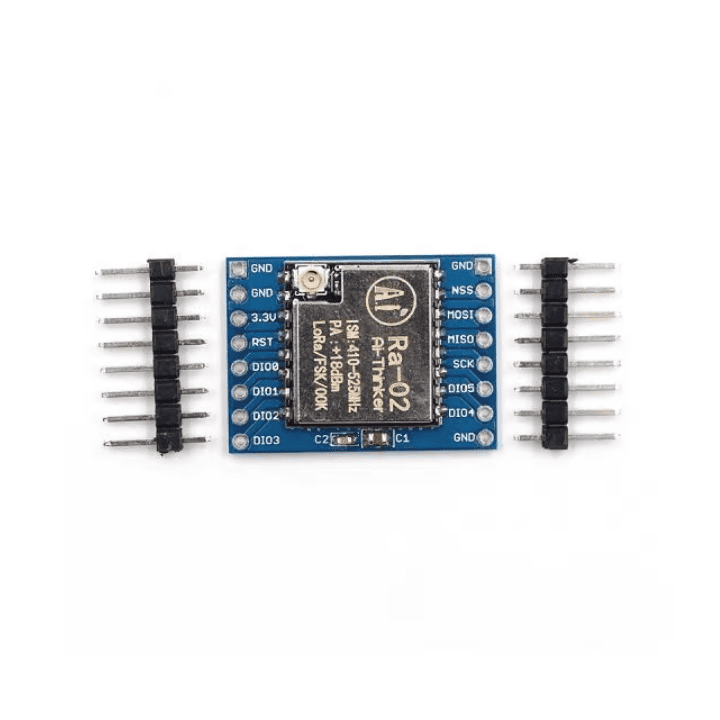


The long-range wireless transmission LoRa module Ra-02 is based on the SEMTECH SX1278 wireless transceiver. This LoRa module uses advanced LoRa spread spectrum technology to provide a communication range of up to 10,000 meters. It has excellent anti-jamming skills and an air wake-up consumption feature.
When evaluating the SX1278 LoRa module range, it stands out for its excellent anti-jamming capability and efficient air wake-up consumption feature, ensuring stable performance even in noisy environments.
The SX 1278 LoRa module is designed mainly for long-range spread spectrum communication and operates with low current consumption. It offers high sensitivity of -148 dBm along with a power output of +20 dBm, making it suitable for extended-distance communication with minimal power usage.
Compared to traditional modulation technologies, LoRa communication provides significant advantages in anti-interference, signal penetration, and power efficiency. The SX1278 transceiver enhances overall communication reliability while maintaining low energy consumption, making it ideal for battery-powered IoT devices.
The SX1278 LoRa module RA-02 433MHz wireless spread spectrum transmission solution is widely preferred for applications that demand long-range, low-power wireless communication. Its ability to maintain stable connectivity over several kilometers makes it a strong alternative to traditional RF modules.
| LoRa Module Pin | Arduino UNO Pin | Notes |
|---|---|---|
| VCC (3.3V) | 3.3V | Provide stable 3.3V supply. Some boards may require external regulator. |
| GND | GND | Common reference for both devices. |
| NSS / CS | D10 | Chip select for SPI communication. |
| DIO0 | D2 | Interrupt pin for packet-ready signaling. |
| SCK | D13 | SPI clock. |
| MISO | D12 | SPI Master-In-Slave-Out. |
| MOSI | D11 | SPI Master-Out-Slave-In. |
| RST | D9 | Reset pin for LoRa module. |
#include <SPI.h>
#include <LoRa.h>

int counter = 0;

void setup() {
  Serial.begin(9600);
  while (!Serial);

  Serial.println("LoRa Sender");
  if (!LoRa.begin(433E6)) {
    Serial.println("Starting LoRa failed!");
    while (1);
  }
  LoRa.setTxPower(20);
}

void loop() {
  Serial.print("Sending packet: ");
  Serial.println(counter);

  LoRa.beginPacket();
  LoRa.print("hello ");
  LoRa.print(counter);
  LoRa.endPacket();

  counter++;
  delay(5000);
}
LoRa.begin(433E6) and read incoming packets.| Feature | SX1278 Module | SX1262 Module | RFM95 Module |
|---|---|---|---|
| Frequency Range | ~137‑525 MHz (commonly 433/470 MHz) | ~150‑960 MHz (broad frequency support) | Typically 868/915 MHz (depends on variant) |
| Maximum Transmit Power | Up to +20 dBm | Up to +22 dBm | Up to +20 dBm (varies with module) |
| Receiver Sensitivity | Down to ~‑139 dBm | Down to ~‑148 dBm | ~‑148 dBm (depending on version) |
| Power Consumption / Efficiency | Higher RX current, less efficient | Much improved efficiency, lower RX current | Good efficiency, similar to SX127x series |
| Package / Size | Larger 6×6 mm QFN, older design | Smaller 4×4 mm QFN, newer generation | Module size similar to SX127x based modules |
| Ideal Use Case | Cost-sensitive, 433 MHz or legacy 868/915 projects | Battery-powered, long-term deployments, broad frequency support | Strong 868/915 MHz coverage, general purpose LoRa usage |
| Drawbacks | Older generation, less efficient, limited bandwidth | Higher cost, more complex features may be overkill for simple use | May not offer lowest current draw compared to newest chips |
| Working voltage | 1.8-3.7v |
| Communication distance | 15KM |
| Sensitivity | down to -148dBm |
| Programmable bit rates | up to 300kbps |
| RSSI dynamic range | 127dB |
| Wireless frequency | 433MHz |
To connect the SX1278 LoRa module, you must use a 3.3V logic level for power and for the SPI pins (MOSI, MISO, SCK, NSS). Once wired, you can use a dedicated LoRa library within the Arduino IDE to establish communication and control the module. Be sure to correctly map the pin definitions in your code.
You can configure your Ra-02 module for long-distance wireless communication by adjusting its LoRa parameters in your code. Increasing the spreading factor and decreasing the signal bandwidth will maximize range, though it will also reduce the data transmission rate. These settings are key to balancing range and speed for your specific application.
To send data, you first need to initialize the SX1278 433MHz LoRa module using a suitable library in your code. You can then package your information into data packets and use a function like LoRa.beginPacket() to transmit them. This method provides reliable long-range wireless communication.
To receive data, you must configure a second SX1278 LoRa module to be in a continuous listening mode. Your code should periodically check for incoming packets using a function from your LoRa library, such as LoRa.parsePacket(). LoRa technology ensures robust signal reception even in noisy RF environments.
First, verify that your Ra-02 module has a stable 3.3V power supply and that all your wiring, especially the SPI connections, is correct. Next, double-check your code configuration to ensure both the sender and receiver are using the same frequency and LoRa parameters. Incorrect settings are a common source of connectivity problems.
Yes, you can create a network using multiple SX1278 modules by assigning them all the same LoRa communication parameters, such as frequency and spreading factor. To distinguish them, you should assign unique addresses to each node within your code. This allows for organized data exchange between specific modules.
The wireless transceiver module SX1278 utilizes the LoRa platform, designed for IoT applications. This module communicates via the SPI protocol and can be used with any microcontroller supporting SPI. To ensure proper functioning, the module must be powered with 3.3V, and its 16 pins (8 on each side) must be connected to the uP/uC via the SPI line. It's critical to use an antenna with the module to prevent permanent damage. The module is designed to work with a standard 50-? impedance and comes with a spring coil antenna.
The SX1278 LoRa transceiver utilizes Semtech's patented LoRa modulation technique to enable ultra-long range spread spectrum communication and high interference immunity with low current consumption. It communicates via the SPI protocol and is compatible with any microcontroller that supports SPI. The module can be effortlessly connected to an Arduino board for transmitting and receiving data. Additionally, there are YouTube tutorials available for getting started with the LoRa SX1278 module.
LoRa is a wireless platform designed for IoT applications. It utilizes a proprietary radio communication technique based on spread spectrum modulation derived from CSS technology. LoRa is well-suited for applications that require low bit rates and transmit small data chunks over long distances, which outperforms technologies like WiFi, Bluetooth, or ZigBee. The platform is well-suited for low power mode sensors and actuators. To ensure the interoperability of all LoRaWAN products and technologies, a standard protocol known as LoRaWAN is used.
The SX1278 433MHz LoRa module can achieve transmission distances of 1–2 km in urban areas and over 10 km in open-line-of-sight conditions. Range depends on factors like antenna quality, environmental interference, and transmission power. Its long reach makes it perfect for low-power, wide-area network applications.
The LoRa RA 02 supports a maximum output power of 20 dBm, allowing strong signal transmission over extended distances. This high power output enhances link reliability, especially in noisy RF environments. It’s well-suited for battery-powered devices where long-range and energy efficiency are critical.
The SX1278 has a standard RF impedance of 50 ohms, which must match your antenna and PCB trace design for optimal performance. Using a 50 ohm antenna ensures maximum power transfer and minimizes signal reflection. This matching is essential for achieving the best range and signal integrity.
The SX1278 LoRa module supports configurable data rates from 0.3 kbps to 37.5 kbps, balancing speed and range based on your application needs. While it doesn’t offer high-speed transfer, its focus on long-range and low-power operation makes it ideal for IoT applications where reliable, intermittent data transmission is key.